
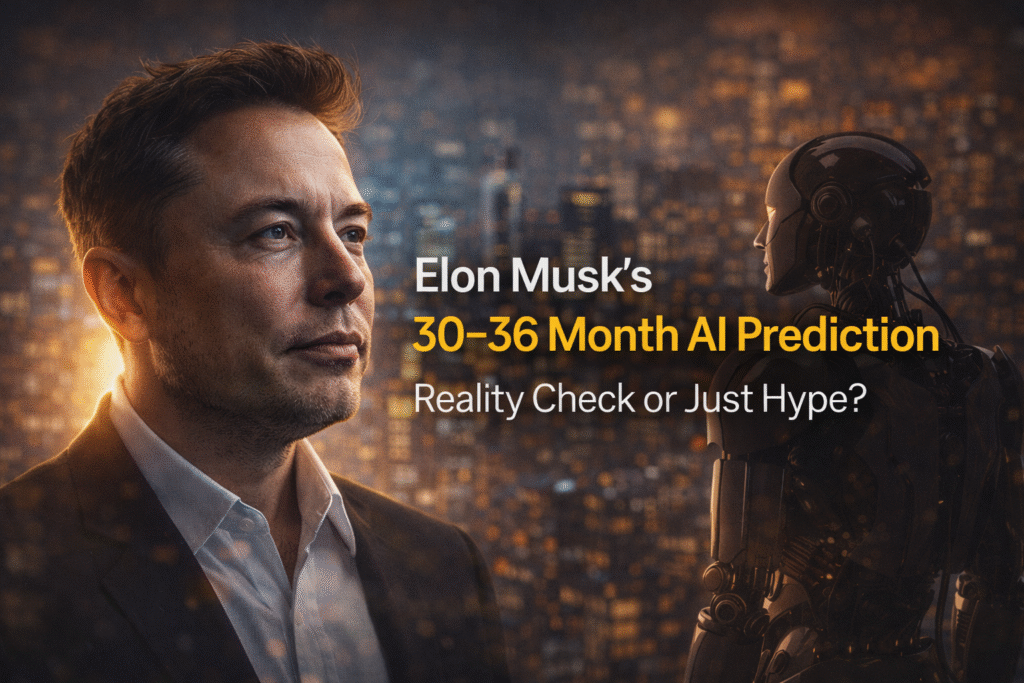
Elon Musk AI Prediction Bold Timeline That’s Hard to Ignore
Elon Musk AI prediction, a strong claim about artificial intelligence.
According to him, the next 30 to 36 months could bring dramatic changes in AI capabilities. In other words, he believes we are extremely close to a major shift in how powerful AI systems become.
Statements like this naturally grab attention.
However, bold predictions about AI are not new. What makes this one different is the timeframe. Three years is not “the distant future.” It is immediate. It affects businesses, careers, and everyday life now.
So the real question is:
Is this hype?
Or is this a realistic warning?
What Musk Is Suggesting — In Simple Terms
The core idea behind the statement is this:
AI systems are improving at an exponential pace. If that growth continues, we could see intelligence levels that significantly exceed today’s systems — and possibly surpass human-level reasoning in many domains.
Now, that doesn’t mean robots take over tomorrow.
Instead, it suggests:
- AI becomes more autonomous
- AI systems require less human supervision
- AI performs more complex tasks independently
- AI integrates deeper into industries
The emphasis is on speed of advancement, not just improvement.
Why Some Experts Take This Seriously
AI development over the last few years has been unusually fast.
Consider what has changed recently:
- Large language models now handle reasoning, coding, and analysis
- AI tools assist in research and content creation
- Real-time AI search engines are replacing traditional browsing
- AI copilots are embedded in office software
Three years ago, many of these capabilities were early-stage or limited.
Because of that acceleration, predictions about rapid progress no longer sound unrealistic.
Why Others Urge Caution
At the same time, many researchers argue that:
- AI still lacks true understanding
- AI struggles with reasoning consistency
- Safety alignment remains unresolved
- Infrastructure and regulation move slower than innovation
In other words, progress is fast — but not frictionless.
Real-world systems face:
- energy limits
- hardware constraints
- policy challenges
- ethical boundaries
Technology rarely scales smoothly without obstacles.
What “30–36 Months” Could Actually Mean
Instead of interpreting the timeline dramatically, it may be more practical to interpret it structurally.
In the next few years, we are likely to see:
1. Smarter AI Assistants
AI tools that:
- manage tasks
- analyze documents
- assist in decision-making
- coordinate workflows
Not replacing humans, but augmenting them more deeply.
2. Industry-Specific AI Integration
Rather than general chat tools, expect:
- AI in healthcare diagnostics
- AI in financial risk analysis
- AI in legal document review
- AI in supply chain management
The transformation may be specialized, not cinematic.
3. Increased Regulatory Attention
As AI grows more capable, governments will likely:
- tighten oversight
- implement compliance frameworks
- define safety requirements
Rapid growth often triggers regulation.
The Real Risk: Speed Outpacing Understanding
One consistent concern among experts is not intelligence alone.
It is the gap between:
- capability
- safety
- governance
- public understanding
If AI improves faster than we build guardrails, uncertainty increases.
This is why conversations around AI are no longer purely technical. They are economic, ethical, and social.
Should Professionals Be Worried?
Panic rarely leads to good decisions.
Instead of asking:
“Will AI replace me?”
A better question is:
“How can I work effectively with increasingly capable AI?”
In the next three years, the most valuable skills are likely to be:
- critical thinking
- adaptability
- AI literacy
- decision-making
- ethical awareness
These are not technical skills. They are human strengths.
Why Predictions Like This Matter
Even if the timeline is slightly exaggerated, bold statements serve a purpose.
They:
- push awareness
- accelerate preparation
- encourage policy discussions
- influence investment decisions
Technology history shows that disruptive shifts often feel exaggerated — until they aren’t.
The Balanced Perspective
There are three reasonable possibilities:
- AI progress slows due to technical limits
- AI improves steadily but not explosively
- AI capabilities accelerate faster than expected
No one can predict with certainty.
However, ignoring the conversation is not wise.
What Individuals Should Do Now
Rather than reacting emotionally, consider practical steps:
- Learn how AI tools work at a basic level
- Use AI as a productivity assistant
- Stay informed without falling into hype
- Strengthen uniquely human skills
- Follow credible sources, not viral headlines
Preparation beats prediction.
Final Thoughts
Elon Musk’s 30–36 month claim may sound dramatic.
Yet even if the timeline shifts slightly, one reality remains clear:
AI development is not slowing down.
The next few years will likely reshape:
- how we work
- how we search
- how we create
- how we make decisions
The smartest approach is neither fear nor blind optimism.
It is informed awareness.
AI will continue evolving.
The real question is whether we evolve with it.
What to Read Next
- 10 Smart Ways to Use Perplexity for Daily Productivity & Learning
- 12 AI Skills Every Non-Technical Professional Should Learn
- Perplexity AI Explained Simply
Notion Pack
AI Skills Prompt Pack – Download here