
This Is Where AI Starts “Creating”
Most people use AI to:
- answer questions
- write content
- summarize text
But there’s another side of AI.
The side that creates:
- fake humans
- AI art
- deepfakes
- synthetic images
This is where GANs come in.
What Are GANs?
GAN stands for:
👉 Generative Adversarial Networks
Sounds complicated.
But the core idea is surprisingly simple:
AI learns to create fake things that look real.
The Core Concept (Very Important)
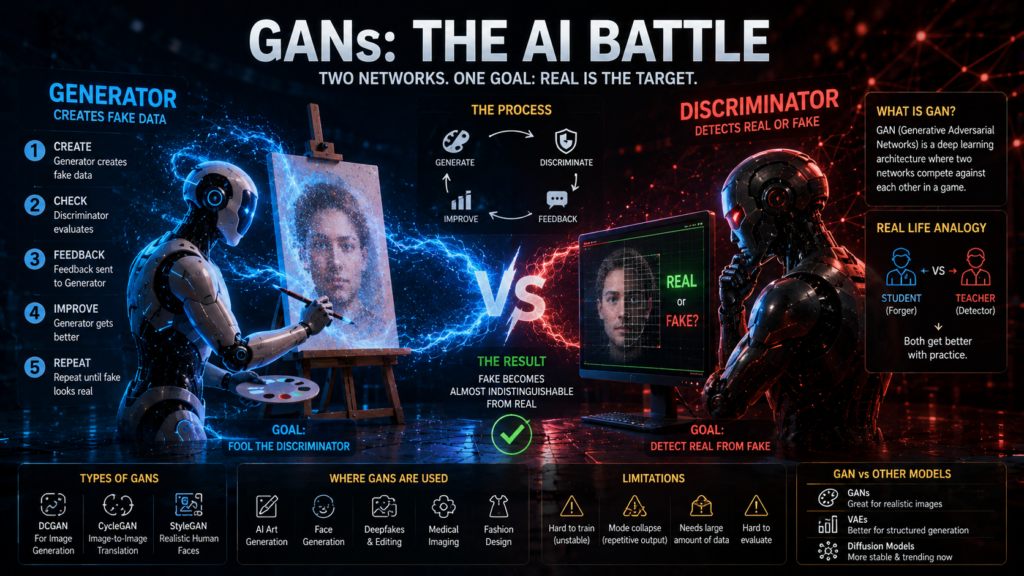
GANs work using two AI systems competing against each other.
1. Generator
Creates fake data.
Example:
- fake face
- fake artwork
- fake image
2. Discriminator
Acts like a detector.
Its job:
- check if something is real or fake
The Full Process
It works like this:
- Generator creates fake image
- Discriminator checks it
- Feedback is given
- Generator improves
- Repeat thousands of times
Over time:
👉 the fake becomes extremely realistic
The Easiest Analogy
Imagine:
A student tries to forge a signature.
A teacher tries to detect fake signatures.
At first:
- the fake is obvious
But after repeated attempts:
- the student becomes better
- the teacher becomes sharper
Eventually:
- the fake looks almost real
That’s GANs.
Why GANs Became Revolutionary
Before GANs, AI-generated images looked:
- blurry
- unrealistic
- unnatural
GANs changed everything.
Suddenly AI could generate:
- realistic human faces
- high-quality art
- synthetic photography
This was a massive breakthrough.
Real Examples You Already Know
You’ve probably seen GAN-generated content without realizing it.
AI Faces
Websites like:
“ThisPersonDoesNotExist”
generate humans that never existed.
Most of these systems were powered by GAN-style architectures.
Deepfakes
Face swapping in:
- movies
- social media
- viral videos
GANs played a major role in early deepfake technology.
AI Art
Many early AI art systems used GANs before diffusion models became popular.
Different Types of GANs
You don’t need to memorize these.
But understanding the idea helps.
DCGAN
Focused on image generation.
CycleGAN
Transforms one image into another.
Example:
- horse → zebra
- summer → winter
StyleGAN
Created ultra-realistic human faces.
This became one of the most famous GAN architectures.
Why GANs Are Difficult
GANs are powerful.
But also unstable.
The Biggest Problem: Mode Collapse
This happens when AI keeps generating similar outputs repeatedly.
Example:
- same face structure
- same patterns
Instead of diversity.
Why Modern AI Is Moving Beyond GANs
Today, diffusion models are becoming more popular.
Why?
Because they are:
- more stable
- more controllable
- better at high-quality generation
Tools like modern AI image generators rely heavily on diffusion approaches.
GANs vs Diffusion Models
GANs
- faster generation
- highly realistic images
- harder to train
Diffusion Models
- slower
- more stable
- dominate modern AI image generation today
The Real Insight
GANs were one of the biggest turning points in generative AI.
They proved something important:
👉 AI can create — not just analyze
That changed the entire industry.
Why This Matters Today
Even if you never build a GAN yourself, understanding them helps you understand:
- deepfakes
- AI-generated media
- synthetic content
- modern image AI tools
Final Thoughts
GANs showed the world that AI could imitate reality.
And once AI learned to generate convincing fake data…
everything changed.
What to Read Next
- How to Learn Faster Using ChatGPT
- Best Programmers Don’t Write Code Anymore
- Complete Agentic AI Roadmap for Beginners (No Coding Required in 2026)
- Free AI Courses for Non-Coders
Notion Pack
Work Intelligence Prompt Pack – Download here